

West Virginia STD Testing Directory
To help you locate an accredited laboratory/testing center, a list of resources has been compiled and can be found below.
Consult with your health care provider about any lab testing that you may be considering. It is also important to follow up with your health care provider to discuss your results within the context of your medical history.
STD Trends in West Virginia
West Virginia’s reported STDs are below average, although congenital syphilis rates are close to the national average. In West Virginia, some underlying causes of increased STDs relate to a complex network of social factors. Some of these factors may include economic disparities that prevent access to appropriate health care, substance use, homelessness, and the exchange of sex for money or other resources. Startling trends seen in West Virginia include:
| STD Trends in West Virginia | |||
|---|---|---|---|
| State rank | Cases | Rate per 100,000 population | |
| Chlamydia | 47th | 5,431 | 303.0 |
| Gonorrhea | 44th | 1,780 | 99.3 |
| Syphilis | 38th | 127 | 7.1 |
| Congenital syphilis | 16th | 8 | 44.1 |
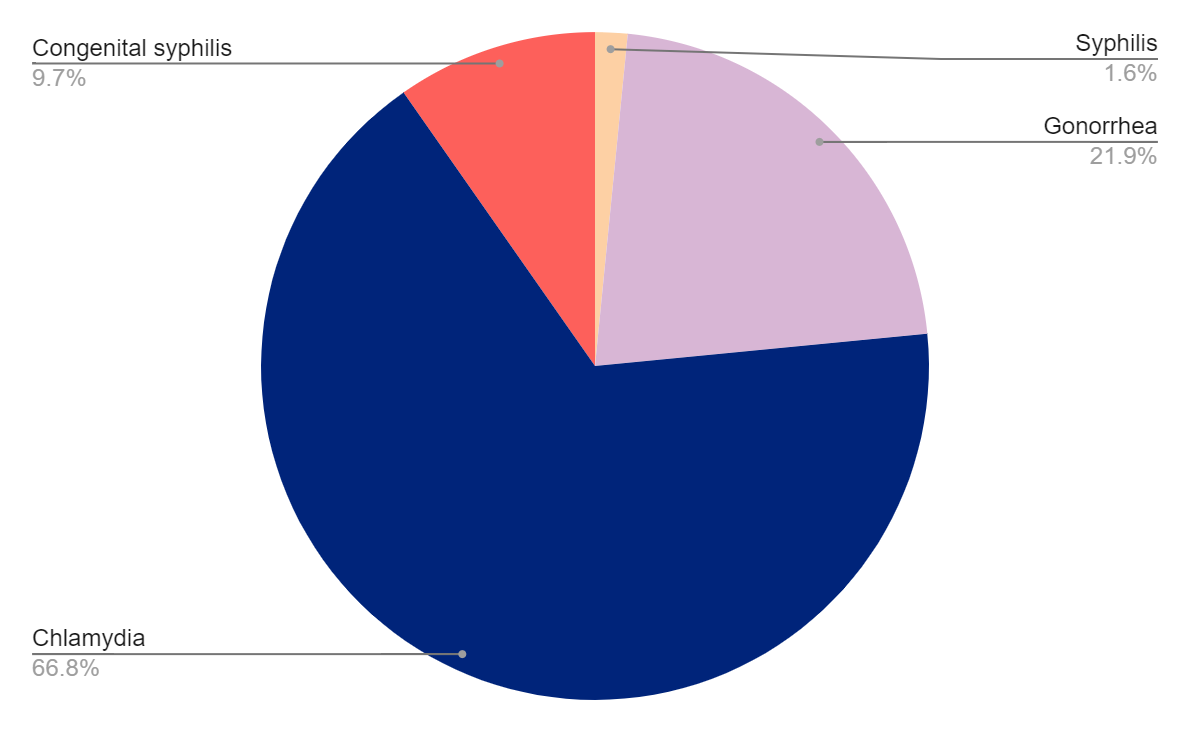
Source: CDC 2020 STD Surveillance Report
STD Screening Recommendations and Risk Factors
If you have sex, you are at risk for getting an STD. According to the CDC, risk factors for STDs include:
- Unprotected sex (anal, vaginal, or oral)
- Sex with multiple partners
- Anonymous sex partners
- Sex under the influence of drugs or alcohol
- Injection of drugs or sharing needles
Should you get tested for STDs? And how often? Talk to your doctor to be sure, but you should generally follow these CDC recommendations:
| Who should get tested | How often to test |
|---|---|
| Anyone who is sexually active | At least once for HIV and more often if you have new partners |
| Sexually active women under 25 or women 25+ with new or multiple sex partners or a partner with an STD | Annually for gonorrhea and chlamydia |
| Pregnant women | During pregnancy for syphilis, HIV, hepatitis B and C, chlamydia, gonorrhea |
| Sexually active gay, bisexual, and other men who have sex with men |
|
| Anyone who has unsafe sex or shares injection drug equipment | Annually for HIV and Hepatitis B and C |
| People who have had oral or anal sex | Discuss throat and rectal testing with your health care provider |
STD Testing in West Virginia:
Free STD Testing Centers in West Virginia
Community-based STD testing organizations help expand access to sexual health services by offering affordable, confidential testing and treatment.
You may choose a community testing center if cost, insurance coverage, privacy, or access to a regular healthcare provider is a concern. While some centers charge a small fee, many offer free or low-cost STD testing and additional support services. Below are examples of community-based resources where reduced-cost testing may be available.
- Cabell-Huntington Health Department
Address: 1336 Hal Greer Boulevard, Huntington, WV 25701Number: (304) 523-6483 - Kanawha-Charleston Health Department
Address: 108 Lee Street East, Charleston, WV 25301Number: (304) 348-8080 - Mid-Ohio Valley Health Department
Address: 211 Sixth Street, Parkersburg, WV 26101Number: (304) 485-7374 - Monongalia County Health Department
Address: 453 Van Voorhis Road, Morgantown, WV 26505Number: (304) 598-5119 - West Virginia Bureau for Public Health
Address: 350 Capitol Street, Room 125, Charleston, WV 25301Number: (304) 558-2195 or (800) 642-8244 - Wheeling-Ohio Health Department
Address: 1500 Chapline Street, Room 106, Wheeling, WV 26003Number: (304) 234-3682