
In January 2026, Testing.com surveyed 2,520 U.S. Gen Z adults (ages 18 to 29) to understand how this generation is using AI chatbots to obtain medical information.
The survey found that about 41% of Gen Zers have asked an AI chatbot for medical advice, and among those who’ve turned to AI for health questions, roughly half say they’ve asked specifically about STIs/STDs.
Survey highlights:
- 41% of Gen Z adults have asked AI chatbots for medical advice.
- 20% of Gen Z adults have asked AI chatbots about STIs/STDs, and about half of this group sought out a diagnosis.
- 1 in 3 users say they were misdiagnosed by AI.
- 9 in 10 users are likely to leverage an AI chatbot again for STI/STD questions.
Gen Z Is Sharing Photos With AI To Diagnose STDs
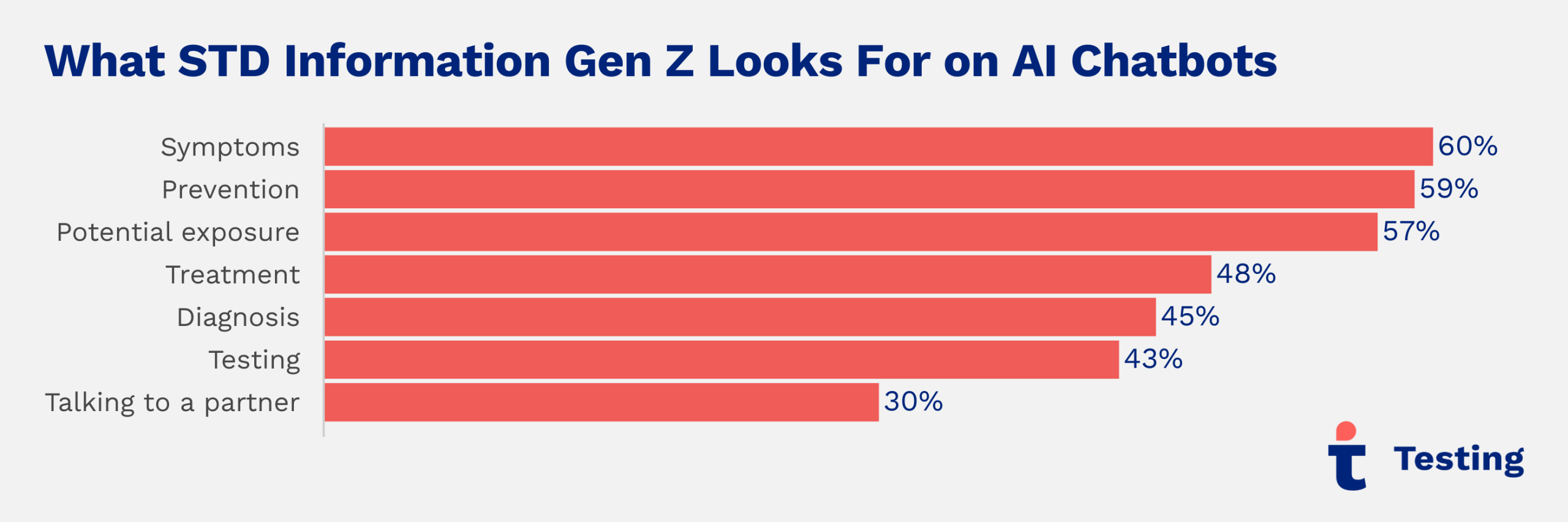
Among Gen Zers who asked ChatGPT about STIs/STDs, the most common topics were symptoms (60%), prevention (59%), and possible exposure (57%). Nearly half asked about treatment (48%) or diagnosis (45%). In addition, 43% asked about getting tested, and 30% asked how to talk to a partner.
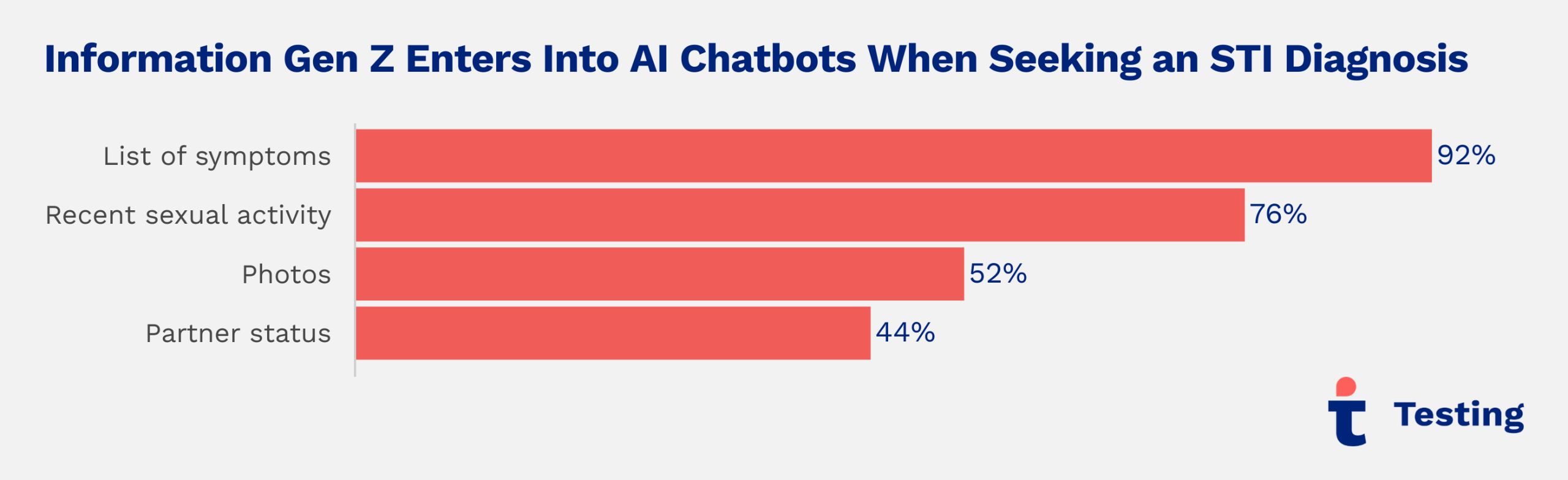
When Gen Zers asked ChatGPT to help diagnose an STI/STD, most provided specific details. Nearly all shared a list of symptoms (92%), and 76% shared information about recent sexual activity or possible exposure. More than half shared photos (52%), and 44% shared a partner’s known STI/STD status.
Based on the information submitted, 45% say the chatbot indicated they had an STI/STD, 36% say it indicated they did not, and 17% say it was unsure.
“An AI chatbot can be a starting point for general education, but it shouldn’t be used as a diagnostic tool for an STI,” says Toni Brayer, M.D., an internal medicine doctor and member of Testing.com’s medical review board. “The information provided is dependent upon the question asked, and many symptoms can be caused by non-STD conditions. A chatbot is not a replacement for medical professionals or actual testing (blood tests, urine tests, swabs, and cultures), which is still the only way to confirm infection. If a chatbot leads someone to delay testing, delay treatment, or avoid notifying a partner, that’s where the real harm happens.”
AI Misdiagnosed Nearly One-Third of Users
After their diagnostic conversation with ChatGPT, 74% of users say they got tested for an STI/STD, while 26% did not.
Among those who got tested following the conversation, 31% tested positive and 68% tested negative.
Overall, AI misdiagnosed 31% of people. Among users who say ChatGPT indicated they didn’t have an STI/STD, 15% later tested positive. Among users who say ChatGPT indicated they did have an STI/STD, 53% later tested negative.
“AI chatbots should be used only to gather information, and they are not diagnostic tools,” notes Dr. Brayer. “STIs require lab testing to diagnose accurately. A false negative or a false positive rate of 31% is unacceptable in medical diagnosing. When AI gets it wrong, it can cut both ways: someone may feel falsely reassured and delay care when treatment is needed, or they may be told they have an STI when they don’t, leading to unnecessary anxiety and stress.”
92% Say They’ll Keep Using AI for STD Questions Despite Privacy Concerns
Most respondents report privacy concerns about sharing medical information with AI chatbots. About 29% say they are moderately concerned, 20% say they are very concerned, and 13% are extremely concerned.
Despite those concerns, the intended future use remains high. Overall, 92% say they are very or somewhat likely to talk with an AI chatbot again about STIs/STDs.
Comfort levels also vary by source. When discussing STIs/STDs, 35% say they are more comfortable talking to an AI chatbot, compared with 25% who prefer a medical professional. Another 36% say they are equally comfortable with both.
“When you share sexual health details or photos with an AI chatbot, you don’t have the same privacy protections you’d have in a medical setting under HIPAA. Depending on the platform, information could be stored or used to improve the system. Your personal data can be compromised, sold to vendors, or otherwise used in ways that are harmful. The legal protections are not in place for confidential medical information,” explains Dr. Brayer.
“People should avoid sharing identifiable images or highly specific details and instead speak with a licensed medical provider. Health professionals are trained to confidentially diagnose and treat STDs and to reassure patients if the testing shows no problem.”
Methodology: In January 2026, Testing.com surveyed 2,520 U.S. Gen Z adults ages 18 to 29 using the Pollfish survey platform. Pollfish uses Random Device Engagement (RDE) to reach respondents through in-app surveys rather than opt-in panels, helping reduce fraud and duplicate responses, broaden sample diversity, and improve response quality; attention checks and other fraud-detection tools were used to identify invalid responses. Results are based on self-reported responses.