Colorado Blood Testing Directory
To help you locate an accredited laboratory/testing center, a list of resources has been compiled and can be found below.
Consult with your health care provider about any lab testing that you may be considering. It is also important to follow up with your health care provider to discuss your results within the context of your medical history.
Health Statistics in Colorado
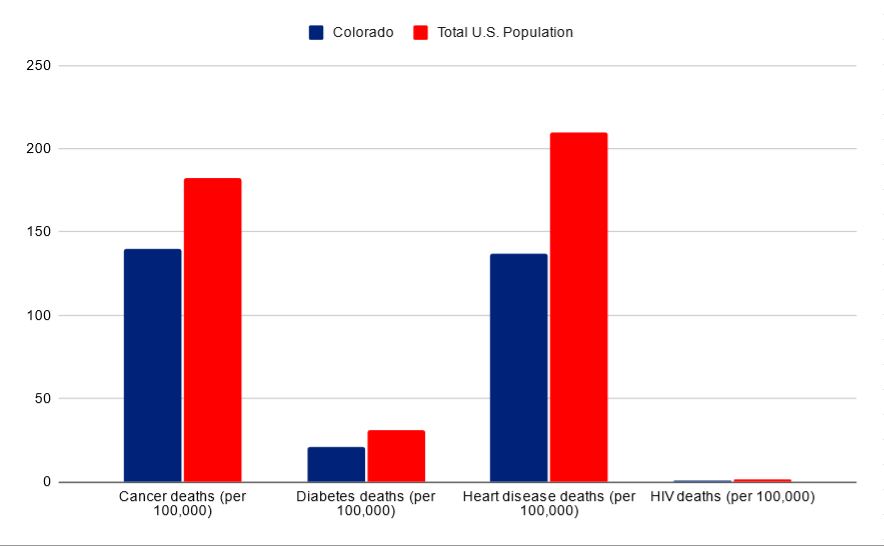
Colorado’s reported deaths for cancer, diabetes, heart disease, and HIV are all under the national average. But with early detection, death rates could be lower. Reported deaths in Colorado include:
|
Colorado |
Total U.S. Population |
| Cancer deaths (per 100,000) |
139.5 |
182.6 |
| Diabetes deaths (per 100,000) |
20.9 |
31.4 |
| Heart disease deaths (per 100,000) |
136.6 |
209.4 |
| HIV deaths (per 100,000) |
0.7 |
1.5 |

Source: CDC National Center for Health Statistics Mortality Dashboard
Common Blood Tests
Should you get a blood test? Learn about some of the most common blood tests and what they’re used for.
| Test |
What it’s used for |
| Basic metabolic panel (BMP) |
- Overall health screening
- Kidney function
- Blood glucose
- Calcium
- Electrolytes
|
| Blood clotting test |
- Bleeding disorders
- Blood clotting disorders
- Platelet disorders
|
| Complete blood count (CBC) |
- Anemia
- Bleeding disorders
- Blood cholesterol
- Blood clotting disorders
- Sickle cell disease
- Thalassemia
|
| Lipid panel |
- Atherosclerosis
- Blood cholesterol
- Coronary heart disease
- High blood triglycerides
|
| STD panel |
- HIV
- Herpes 1 and 2
- Chlamydia
- Gonorrhea
- Syphilis
- Hepatitis A, B, and C
|
Blood Testing in Colorado:
Community-based health testing organizations generate awareness and foster social change while providing access to testing and treatment.
If you’re concerned about visiting your regular doctor or can’t afford the cost of private testing, a community testing center may be able to help. While community testing centers may charge a fee for blood testing, it’s common to find free or low-cost testing from these resources:
- Boulder Community HealthAddress: Community Medical Center, 1000 W. South Boulder Rd., Lafayette, CO Number: (303) 415-4300
- Centennial State LaboratoryAddress: 4775 Centennial Blvd., Suite 112, Colorado Springs, CO 80919 Number: (719) 284-3522
- OnPoint Urgent Care Lone TreeAddress: 9695 S. Yosemite St., Suite 150, Lone Tree, CO 80124 Number: (720) 575-3959
- Rocky Mountain LabsAddress: 195 Inverness Dr. W., Suite 120, Englewood, CO 80112 Number: (303) 552-0657
- Swedish Medical CenterAddress: 501 E. Hampden Ave., Englewood, CO 80113 Number: (303) 788-5000
- UCHealth Laboratory (Cherry Creek)Address: 100 Cook St., Suite 200, Denver, CO 80206 Number: (720) 516-9412
Frequently Asked Questions About Blood Tests in Colorado
Can I order my own blood tests in Colorado?
Depending on the test, you can usually order your own blood tests in Colorado.
Can I request a blood test without seeing a doctor?
Some blood tests can be ordered online as an at-home kit, or you can go directly to a lab without first getting a doctor’s prescription. This is known as direct access testing or direct-to-consumer testing, and it’s becoming more commonplace.
How much does blood testing cost in Colorado?
Blood testing pricing can vary depending on the test type, where and how you get it, and what your health insurance plan covers. In some cases, you may be able to find free or low-cost blood tests at certain community or nonprofit clinics. You should be partially covered for most routine blood work if you have insurance. Those without insurance may qualify for financial assistance or a sliding scale fee.
Can I use insurance to get my blood tested?
When in doubt, you can call your health plan to ask what you are covered for. Your health insurance will usually cover or partially pay for lab services. You may be responsible for copayments or deductibles.
How often should I get my blood tested?
Getting your blood tested once yearly is fairly standard if you don’t have any chronic conditions or take medications. If your levels need to be monitored more frequently, a doctor will let you know how often you should get tested.
Can you eat or drink while fasting for a blood test?
This depends on the type of blood test. For some, there are no restrictions, while others are most accurate if you don’t eat or drink beforehand. Be sure to follow any pre-testing instructions given, and if you’re not sure, call your health care provider.
What does routine blood work check for?
Routine blood work is used to see if certain levels in your blood are within normal limits. Lower or higher than normal results can help a doctor diagnose you or rule out other conditions.
One common routine blood test includes a complete blood count, which measures the number of red blood cells, white blood cells, platelets, and hemoglobin. Another is the basic metabolic panel, which measures blood glucose, calcium, and electrolyte levels.
Health Resources in Colorado
Learn more about health and how blood testing can help you manage your well-being. Numerous authoritative resources at the state and national levels provide valuable information about the most common health conditions, blood tests, and wellness.