Iowa Blood Testing Directory
To help you locate an accredited laboratory/testing center, a list of resources has been compiled and can be found below.
Consult with your health care provider about any lab testing that you may be considering. It is also important to follow up with your health care provider to discuss your results within the context of your medical history.
Health Statistics in Iowa
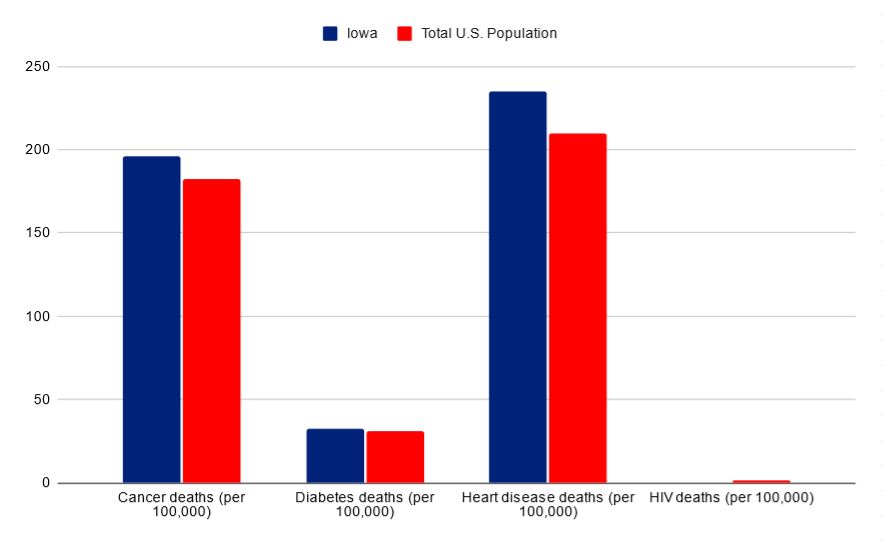
Iowa’s reported deaths for cancer, diabetes, heart disease, and HIV are higher than the national average. With early detection, death rates could be lower, and blood testing is a way to better understand your health status. Reported deaths in Iowa include:
|
Iowa |
Total U.S. Population |
| Cancer deaths (per 100,000) |
195.8 |
182.6 |
| Diabetes deaths (per 100,000) |
32.2 |
31.4 |
| Heart disease deaths (per 100,000) |
235.1 |
209.4 |
| HIV deaths (per 100,000) |
0 |
1.5 |

Source: CDC National Center for Health Statistics Mortality Dashboard
Common Blood Tests
Should you get a blood test? Learn about some of the most common blood tests and what they’re used for.
| Test |
What it’s used for |
| Basic metabolic panel (BMP) |
- Overall health screening
- Kidney function
- Blood glucose
- Calcium
- Electrolytes
|
| Blood clotting test |
- Bleeding disorders
- Blood clotting disorders
- Platelet disorders
|
| Complete blood count (CBC) |
- Anemia
- Bleeding disorders
- Blood cholesterol
- Blood clotting disorders
- Sickle cell disease
- Thalassemia
|
| Lipid panel |
- Atherosclerosis
- Blood cholesterol
- Coronary heart disease
- High blood triglycerides
|
| STD panel |
- HIV
- Herpes 1 and 2
- Chlamydia
- Gonorrhea
- Syphilis
- Hepatitis A, B, and C
|
Community-based health testing organizations generate awareness and foster social change while providing access to testing and treatment.
If you’re concerned about visiting your regular doctor or can’t afford the cost of private testing, a community testing center may be able to help. While community testing centers may charge a fee for blood testing, it’s common to find free or low-cost testing from these resources:
- Community Health Care (CHC) Davenport Medical ClinicAddress: 500 W. River Dr., Davenport, IA 52801 Number: (563) 336-3000
- Genesis Health GroupAddress: 3200 W. Kimberly Rd., Davenport, IA 52806 Number: (563) 421-0060
- MedLabs DowntownAddress: 717 A Ave. NE, Suite 202, Cedar Rapids, IA 52401 Number: (319) 727-8294
- MercyOne Des Moines LaboratoryAddress: 1111 6th Ave., Des Moines, IA 50314 Number: (515) 247-4439
- Planned Parenthood Sioux City Health CenterAddress: 4409 Stone Ave., Sioux City, IA 51106 Number: (877) 859-0586
- UnityPoint Health Pathology LaboratoryAddress: 1212 Pleasant St., LL9, Des Moines, IA 50309 Number: (515) 241-5119
- Weland Clinical LaboratoriesAddress: 1911 First Ave. SE, Cedar Rapids, IA 52402 Number: (319) 366-1503
Frequently Asked Questions About Blood Tests in Iowa
Can I order my own blood tests in Iowa?
Yes, you can order your blood tests in Iowa, depending on the test.
Can I request a blood test without seeing a doctor?
Nowadays, you can get some blood tests done by going directly to a lab or ordering a test online. This is sometimes called direct access testing or direct-to-consumer testing,
How much does blood testing cost in Iowa?
Blood testing costs vary depending on a few factors, including the type of health insurance coverage you have, which test you are getting done, and where it’s being done. Some tests may be free if your insurance covers you or if you visit a free clinic. In general, many affordable options for basic blood work are used in preventative care. Other highly specialized blood tests can be more expensive.
Can I use insurance to get my blood tested?
In some cases, you can use insurance to pay, or partially pay, for blood tests. It’s always best to check with your health insurance plan to see what you’re covered for and if you’re responsible for any copayments or deductibles.
How often should I get my blood tested?
The frequency with which you need your blood tested is a question for your primary care physician. If you are an otherwise healthy person, some bloodwork is usually recommended once per year as part of your general physical exam. But if you have a health condition that requires more frequent monitoring, you may have to get blood tests at different intervals, such as twice per year, four times per year, or every month.
Can you eat or drink while fasting for a blood test?
Some blood tests do require that you fast for a certain number of hours to get more accurate results, while for others, eating and drinking don’t have an impact. When going for a blood test, read and follow pre-testing instructions carefully, or call the lab or your health care provider if you’re unsure.
What does routine blood work check for?
Routine blood work typically checks key levels in your blood to determine if yours are within the normal range. Depending on the test, lower or higher than normal results could indicate a possible infection, a sign that a body system or organ isn’t performing as it should, or it can help rule out conditions to help with diagnosis.
For example, a complete blood count measures your red blood cells, white blood cells, platelets, and hemoglobin. A basic metabolic panel is another common test that measures blood glucose, calcium, and electrolyte levels.
Health Resources in Iowa
Learn more about health and how blood testing can help you manage your well-being. Numerous authoritative resources at the state and national levels provide valuable information about the most common health conditions, blood tests, and wellness.