Oregon Blood Testing Directory
To help you locate an accredited laboratory/testing center, a list of resources has been compiled and can be found below.
Consult with your health care provider about any lab testing that you may be considering. It is also important to follow up with your health care provider to discuss your results within the context of your medical history.
Health Statistics in Oregon
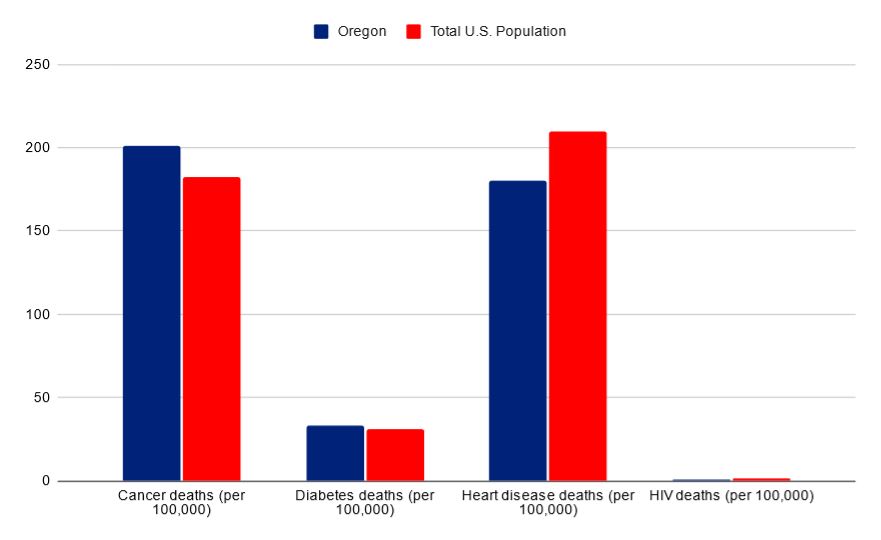
Oregon’s reported deaths for cancer and diabetes are above the national average, while it’s a bit lower for heart disease. But with early detection, death rates could be lower. Reported deaths in Oregon include:
|
Oregon |
Total U.S. Population |
| Cancer deaths (per 100,000) |
200.7 |
182.6 |
| Diabetes deaths (per 100,000) |
33.3 |
31.4 |
| Heart disease deaths (per 100,000) |
180 |
209.4 |
| HIV deaths (per 100,000) |
1.1 |
1.5 |

Source: CDC National Center for Health Statistics Mortality Dashboard
Common Blood Tests
Should you get a blood test? Learn about some of the most common blood tests and what they’re used for.
| Test |
What it’s used for |
| Basic metabolic panel (BMP) |
- Overall health screening
- Kidney function
- Blood glucose
- Calcium
- Electrolytes
|
| Blood clotting test |
- Bleeding disorders
- Blood clotting disorders
- Platelet disorders
|
| Complete blood count (CBC) |
- Anemia
- Bleeding disorders
- Blood cholesterol
- Blood clotting disorders
- Sickle cell disease
- Thalassemia
|
| Lipid panel |
- Atherosclerosis
- Blood cholesterol
- Coronary heart disease
- High blood triglycerides
|
| STD panel |
- HIV
- Herpes 1 and 2
- Chlamydia
- Gonorrhea
- Syphilis
- Hepatitis A, B, and C
|
Community-based health testing organizations generate awareness and foster social change while providing access to testing and treatment.
If you’re concerned about visiting your regular doctor or can’t afford the cost of private testing, a community testing center may be able to help. While community testing centers may charge a fee for blood testing, it’s common to find free or low-cost testing from these resources:
- Asher Community Health CenterAddress: 712 Jay St., Fossil, OR 97830 Number: (541) 763-2725
- Aviva HealthAddress: 150 Kenneth Ford Dr., Roseburg, OR 97470 Number: (541) 672-9596
- Coast Community Health CenterAddress: 1010 First Street SE, Suite 110, Bandon, OR 97411 Number: (541) 347-2529
- Columbia River Health ClinicAddress: 450 Tatone St., Boardman, OR 97818 Number: (541) 481-7212
- Community Health Centers of Benton and Linn CountiesAddress: 530 NW 27th St., Corvallis, OR 97330 Number: (541) 766-6835
- LaPine Community Health CenterAddress: 51600 Huntington Rd., La Pine, OR 97739 Number: (541) 536-3435
- Neighborhood Health Center Oregon City Medical ClinicAddress: 728 Molalla Ave., Oregon City, OR 97045 Number: (503) 656-9030
Frequently Asked Questions About Blood Tests in Oregon
Can I order my own blood tests in Oregon?
Yes, you can order your blood tests in Oregon, depending on the type of test.
Can I request a blood test without seeing a doctor?
Direct access testing or direct-to-consumer testing is becoming more common nowadays. You can go directly to a lab or order a test online.
How much does blood testing cost in Oregon?
Blood testing pricing varies based on factors like your health insurance plan, the type of testing you need, and where you go for it. At certain community clinics, tests may be free or low-cost. You can expect basic blood work to be less expensive than more specialized testing.
Can I use insurance to get my blood tested?
In many cases, your insurance should cover or partially cover the costs of blood tests. Sometimes, you’ll have to meet a deductible or pay a copayment. You can usually find out in advance by asking the lab or calling your health plan.
How often should I get my blood tested?
How often you get blood tests depends on what your doctors recommend. If you have certain kinds of chronic diseases or are taking medications, you may need more frequent blood work than someone who is generally healthy. At a minimum, most people get their blood tested once per year.
Can you eat or drink while fasting for a blood test?
You may have to follow specific instructions regarding eating or drinking before certain types of blood tests. For some tests, there is no need to fast. Be sure to confirm or look over the pre-testing instructions you are given.
What does routine blood work check for?
Regular blood tests keep tabs on the levels of certain elements found in your blood. Results can help a doctor diagnose or rule out different conditions or indicate if you have a certain type of infection. A complete blood count, for example, measures your red blood cells, white blood cells, platelets, and hemoglobin – each of which relates to different body functions.
A basic metabolic panel is another routine test that measures blood glucose, calcium, and electrolyte levels.
Health Resources in Oregon
Blood testing can help you keep tabs on your health, but it’s also important to stay informed and take advantage of resources in your state. Here are some Oregon-specific organizations to check out.